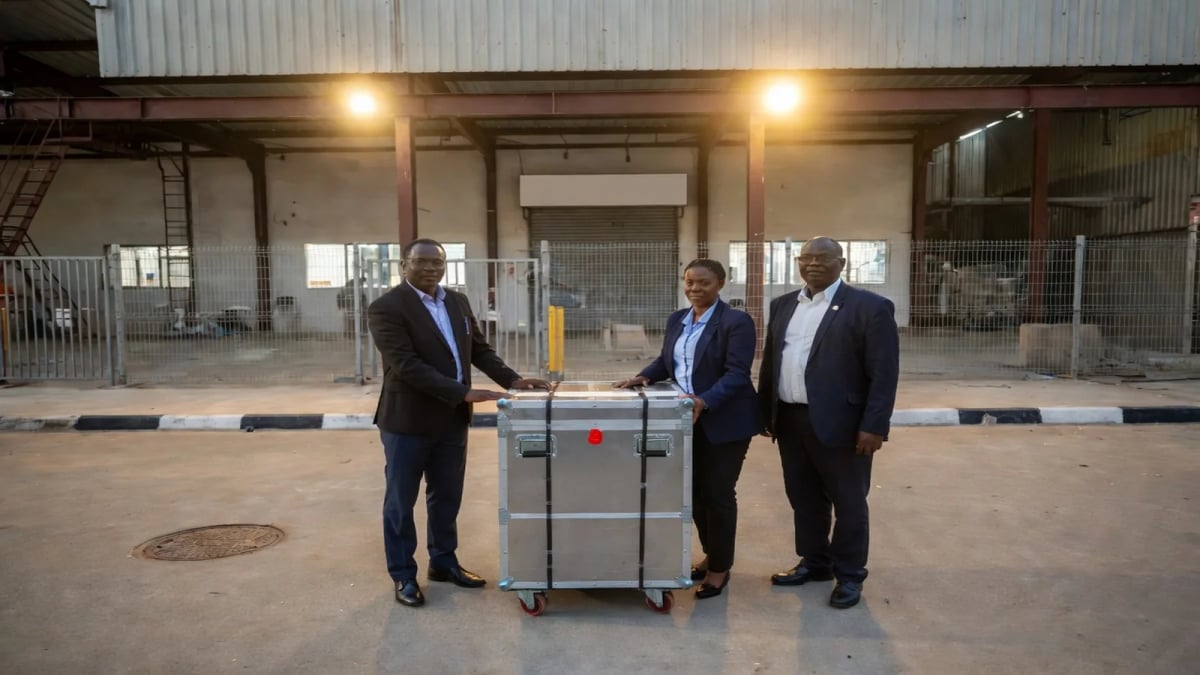
Precious-metals consignment coordination for a refinery
A refinery required coordinated intake of precious-metals consignments with full chain-of-custody documentation and export compliance records. The Project Office managed documentation, scheduling and verified handover from source to refinery intake.
Project Profile
Sector: Precious-metals refinery supply chain Scope: End-to-end consignment coordination — field sourcing, in-country assaying, documentation, and export facilitation Geography: Multi-site, Ghana and Togo Engagement Type: Ongoing institutional supply relationship
A Tier-1 refinery with established processing infrastructure commissioned Ghana Metals to coordinate a structured precious-metals consignment programme spanning artisanal and small-scale mining communities across Ghana and Togo. The engagement required not only reliable material flow but an unbroken chain-of-custody record acceptable to the refinery’s compliance and legal teams.
The Coordination Challenge
Refinery clients operate under strict origin-traceability requirements. Material arriving without complete documentation — point of extraction, in-country assay results, custody transfer records, and responsible-sourcing declarations — cannot enter a compliant processing stream. The challenge here was not simply sourcing volume; it was sourcing with the documentation architecture a Tier-1 refinery’s compliance desk demands.
The engagement also required coordination across two regulatory jurisdictions — Ghana and Togo — each with distinct licensing, export permitting, and mineral declaration frameworks. Inconsistency between the two regulatory environments creates gaps that downstream institutional buyers cannot accept.
Approach
Ghana Metals deployed its full spectrum of trade facilitation services across the consignment cycle.
- Field sourcing and aggregation: Structured engagement with registered ASM operators in both Ghana and Togo, with source verification conducted at point of purchase.
- In-country assaying: Material assayed at verified laboratory facilities before entering any custody transfer — grade, purity, and weight recorded against individual lot references.
- Chain-of-custody documentation: Every transfer point — from field aggregation through assay, secure storage, and pre-export staging — captured in a continuous custody record, formatted to the refinery’s submission specifications.
- Regulatory coordination: Export documentation and mineral declaration submissions managed in parallel across both jurisdictions, ensuring no material moved without fully executed regulatory clearance.
- Responsible-sourcing compliance package: Each consignment accompanied by a responsible-sourcing dossier — provenance declarations, operator due-diligence records, and conflict-mineral attestations aligned to the refinery’s internal compliance framework.
No stage was treated as procedurally routine. Every custody transfer, every assay result, every regulatory filing was handled as a document that would face scrutiny at the refinery’s compliance review.
Outcome
The refinery’s compliance team accepted the consignment documentation without remediation requests — a result that reflects the standard Ghana Metals holds as the baseline, not the exception. Material moved through the export corridor on schedule, with full regulatory clearance across both Ghana and Togo. The responsible-sourcing dossier was integrated directly into the refinery’s supplier record without amendment.
The engagement has continued across multiple consignment cycles, with the refinery’s procurement and compliance functions treating Ghana Metals as the preferred coordination partner for West African origin material.
What This Project Demonstrates
Refineries sourcing from West Africa face a structural documentation problem. Material from Ghana and Togo is commercially viable — but only if the sourcing operation behind it can produce compliance-grade records at every stage of the chain. Most sourcing operations can deliver material. Few can deliver material and the complete custody and compliance architecture a Tier-1 refinery requires.
This engagement demonstrates that responsible sourcing and operational reliability are not competing demands. When chain-of-custody discipline is embedded into the sourcing methodology from the first field contact through to export clearance, the refinery receives what its compliance desk requires — and the supply relationship holds.